
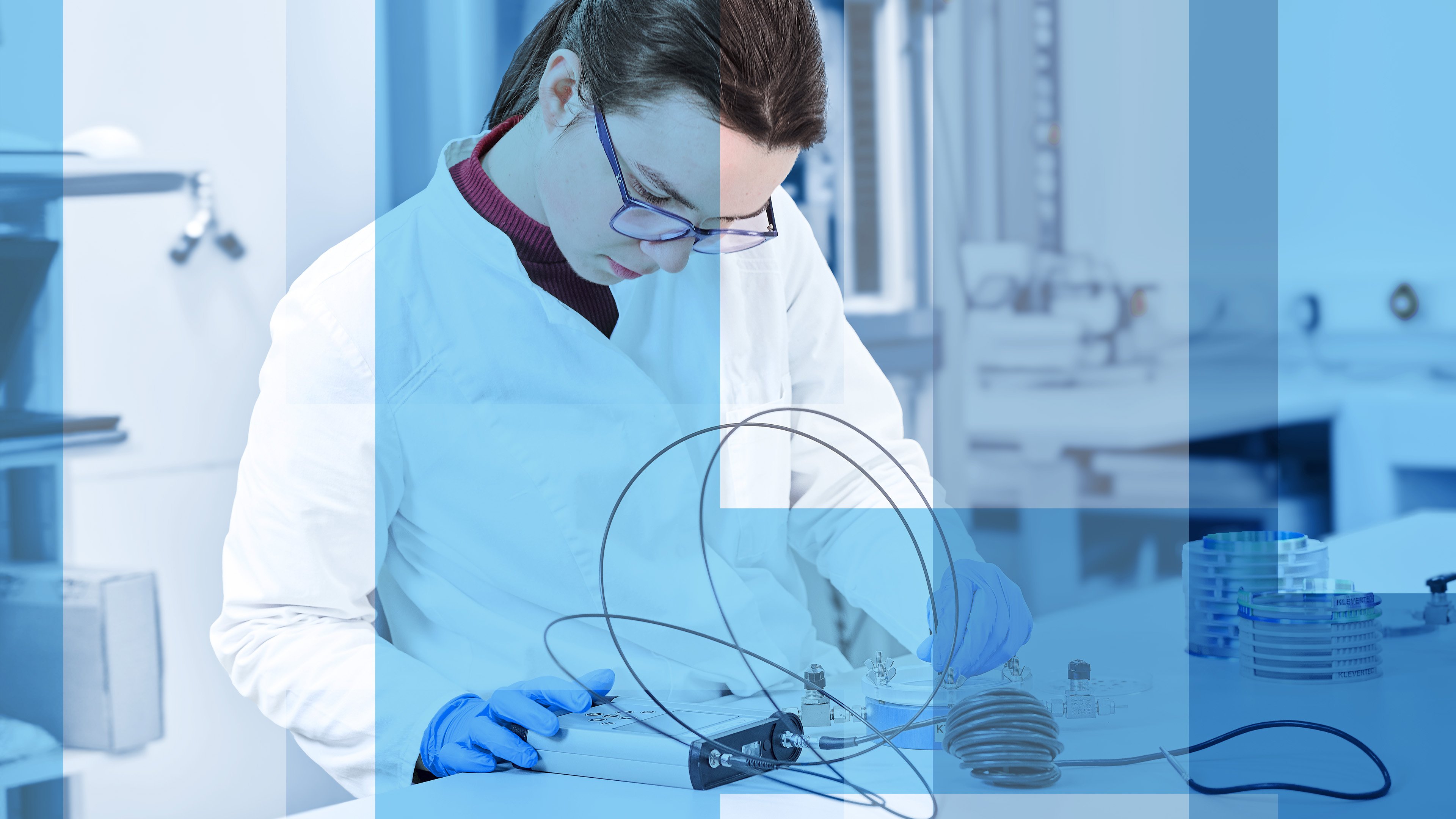
Enthusiastic about technology? Then a degree programme in technology / engineering at Kempten University of Applied Sciences will be right up your street – enabling you to acquire well-founded specialist knowledge and valuable practical experience. It’s the ideal springboard for actively shaping the future of technology. Find the right bachelor’s or master’s degree programme now and apply!
More than 5,000 students already trust in the practice-based, future-focused higher education offered by Kempten University of Applied Sciences.
Study technology at Kempten University of Applied Sciences
An degree in technology from Kempten University of Applied Sciences opens up a wide range of career prospects – from electrical and vehicle engineering through to future-focused fields such as renewable energies, environmental technology and sustainable process engineering.
While studying for a technology degree at Kempten University of Applied Sciences, you will acquire the specialist knowledge you need to develop innovative mobility solutions, work on the energy supply of the future, or optimise materials and production systems. You will learn how to solve complex problems in a practical manner.
State-of-the-art teaching formats, hands-on project work and the close link between theory and practice ensure that you are exceptionally well-prepared to kick-start your career. International exchange programmes, wide-ranging projects and close supervision throughout your studies offer you ideal conditions for deepening your specialist knowledge and gaining new perspectives.
During your technology degree, you will have the opportunity to select your own majors and benefit from international partnerships. This is ideal if you want to view technical challenges from a global perspective. A degree in technology at Kempten University of Applied Sciences offers you top prospects for an exciting, responsible and future-focused career (depending on the degree programme). Find the engineering degree programme now that matches your interests and goals!

“I appreciate how basic theoretical principles and practical application were combined on my degree programme. The personal supervision is a particularly positive aspect – the professors know their students by name and take time for them individually to provide them with the best possible support and encouragement.”

“I have found Kempten to be very nice, the ambience with the people and other students is always friendly and respectful, the experience of being abroad and knowing another culture is enriching. Now if you add to that the students from all around the world on exchange semesters, you get a great experience. I chose Kempten because of the cooperation and agreements it has with my University in Colombia. Before I came, I had already heard good things about their work and knew some of the Kempten students, which encouraged me to do it. Additionally, the official agreement makes it easier for me to get an equivalent degree back in my country.”
-
Master of Science (M. Sc.)
Advanced Driver Assistance Systems [expiring]
Do you want to help shape sustainable mobility and play an active role in improving safety, providing assistance and reducing the stresses involved in driving? By developing state-of-the-art driver assistance systems, you will play a pivotal role in improving vehicles and making manufacturers more competitive.
German 3 winter semester, summer semester -
Master of Science (M. Sc.)
Artificial Intelligence and Computer Vision
Would you like to dive deeper into the world of artificial intelligence and develop processes that enable computers to orient themselves within their environment and help people make decisions? If so, then this is the degree programme for you!
German 3 winter semester, summer semester -
Master of Engineering (M. Eng.)
Automation and Robotics
Have you already honed a keen feeling for complex mechatronic systems during your bachelor’s degree? If so, you can channel your skills into developing future-focused technologies in this master’s degree programme in Automation and Robotics.
German 3 winter semester, summer semester -
Bachelor of Science (B. Sc.)
Business Information Systems
Do you feel the need to venture beyond the binary world? Would you like to combine effective software solutions with business acumen? Then Business Information Systems are your ticket to the wide world of work at the interface between information processing and business administration.
German 7 winter semester -
Bachelor of Science (B. Sc.)
Computer Science
Do you move in digital circles the way others do in the “real” world? Do you simply grasp challenges where others see problems, for which you set about toying with solutions? If so, then this degree programme in Computer Science is right up your street.
German 7 winter semester -
Master of Science (M. Sc.)
Computer Science
Do you want to dive deeper into the substance of computer science, business information systems and similar disciplines and hone your knowledge to your advantage? This master’s in Computer Science equips you outstandingly for application-oriented scientific occupations in industry, administration and research.
German 3 winter semester, summer semester -
Bachelor of Science (B. Sc.)
Computer Science – Game Engineering
Do you have your sights set on developing the latest games and setting PCs and consoles pulsating? Do you have the programming skills to bring tomorrow’s virtual worlds to life? If so, then it’s time to progress to the next level! This bachelor’s degree programme is the perfect gateway to carving out a successful career as a software specialist.
German 7 winter semester -
Master of Engineering (M. Eng.)
Electrical Engineering
Do you want to line up an international career in electrical engineering and information technology? Then studying for this Master’s in Electrical Engineering will empower you to handle the increasingly complex range of tasks faced in globally operative companies.
English 3 winter semester, summer semester -
Bachelor of Engineering (B. Eng.)
Electrical Engineering and Information Technology
You see the world through your eyes. Wondering how it works. How do mobile communication, GPS and renewable energy generation function? You are interested in groundbreaking innovations and new sustainable technologies.
German 7 winter semester -
Master of Engineering (M. Eng.)
Energy Technology
Are you inspired by the world of energy? Do you aspire to play a discerning role in the field of energy technology and want to help shape the energy revolution? Then we can offer you the perfect opportunity to advance your technical and practical expertise!
German 3 winter semester, summer semester


Questions & answers about studying technology
How long does a technical degree programme take?
The time it will take you to graduate in technology at Kempten University of Applied Sciences depends on whether you are taking a bachelor’s - or master’s degree. A bachelor’s degree programme usually comprises seven semesters. It consists of six semesters of studying theory plus one practical semester. If you take all exams as planned, you will graduate punctually with 210 ECTS credit points and the academic degree ‘Bachelor of Engineering (B.Eng.)” or “Bachelor of Science (B. Sc.)”.
Master’s degree programmes usually last three semesters. Upon successful completion, you will be awarded the title of either ‘Master of Engineering (M.Eng.)” or “Master of Science (M. Sc.)” (depending on the degree programme). To obtain a master’s degree, you need to earn 90 ECTS credit points .
In order to comply with the standard duration of studies, it is important to take all examinations on time and pass the required assessed modules and the bachelor’s or master’s thesis with grades of at least “sufficient”. On bachelor’s programmes, the practical semester must also be successfully completed and the credit points required for this must be achieved.
What career opportunities do I have with an engineering degree?
A degree in technology at Kempten University of Applied Sciences offers excellent career prospects. Your career opportunities depend on whether you are aiming for a bachelor’s or master’s degree, and which specific degree programme you choose.
A bachelor’s degree qualifies you for a wide range of specialist and project-related tasks in industry, business or public institutions. Depending on the focus of your studies, after graduating you could work in energy and environmental technology, the automotive sector, electrical engineering and information technology, mechanical engineering or process engineering, for example. Engineers are particularly sought-after in areas such as renewable energies, automation, software development and technical consulting.
A master’s degree also opens up access to management positions, specialised development and research fields, and the opportunity to pursue a doctorate, for example at the Centre for Doctoral Studies in Transformation and Sustainable Development at Kempten University of Applied Sciences.
The broad spread of subject matter and strong practical focus of these degree programmes give you the best possible career prospects, either close to home or on the international stage.
Can I study technology part-time at the same time as working?
Depending on the degree programme and type of degree, a technology degree at Kempten University of Applied Sciences can be combined well with professional demands. The bachelor’s programmes in technology are normally studied full-time , but there are also dual/cooperative studies options if you are keen to gain practical experience early on, while you study.
You can study on our master’s degree programmes either full- or part-time . The part-time format offers you more flexibility and allows you to better combine studying with your career. This allows you to find a way of studying that suits your individual circumstances in life.
Is it possible to study technology remotely?
The technology degrees at Kempten University of Applied Sciences are designed as attendance-based programmes and cannot be studied remotely.
Having said that, our engineering degree programmes offer international options – so you can study for individual semesters or complete practical placements at one of over 100 partner universities worldwide (depending on the degree programme). This enables you to gain valuable international experience.
What do I need to study technology at Kempten University of Applied Sciences?
To study technology at Kempten University of Applied Sciences, you should ideally have a keen interest in scientific matters, especially mathematics, physics and technology. The emphases of the degree programmes vary, but the formal admission requirements are similar.
As a rule, to enrol on a bachelor’s degree programme, you will need to be eligible for admission to higher education, which usually means a high school or college leaving certificate (in Germany: “Abitur” or “Fachhochschulreife”). In addition, your personal motivation is key. You should enjoy understanding technical systems, analysing correlations and developing solutions to complex issues. Your passion for technology is the best basis for successfully studying at degree level.
Additional requirements apply for master’s degree programmes. You need to have completed your first degree in a relevant subject worth at least 210 ECTS Credit Points, having achieved a certain minimum grade, depending on the degree programme, e.g. an average of 2.5 (“good”) or 3.0 (“satisfactory”). If your first degree is worth 180 ECTS, you may be admitted under certain conditions, for example by completing modules or providing evidence of practical professional experience in the field of engineering. The specific requirements for each master’s degree programme are stipulated in the applicable programme and examination regulations.
Are admissions to technology degree programmes capped?
For bachelor’s degree programmes in technology subjects at Kempten University of Applied Sciences, there is currently no cap (“numerus clausus” or “NC”) (depending on the degree programme). If you meet the formal admission requirements, you can apply directly.
For the master’s degree programmes a certain final grade in your previous degree programme is required. Depending on the degree programme, this could be a minimum grade of 2.5 (“good”) or 3.0 (“satisfactory”), for example. Additional criteria, such as a relevant subject for the first degree, might also need to be met. You can find the exact requirements in the subject-specific information about the degree programme in question.
Can I study technology as a dual / cooperative degree programme?
In the field of technology, Kempten University of Applied Sciences offers various opportunities to combine study and practical experience. These bachelor’s degree programmes can be studied both full-time and in dual / cooperative format:
- Electrical Engineering and Information Technology
- Renewable Energies and Environmental Engineering
- Vehicle Engineering
- Food and Packaging Technology
- Mechanical Engineering
- Mechatronics
- Robotics
- Industrial Engineering – Mechanical Engineering
- Industrial Engineering for Technology and Sustainability
Two additional options with extra practical experience are also available: Studying on a degree programme with extended practice enables you to combine a regular bachelor’s degree with longer practical placements at a company. The content of these placements is closely matched to your progression with studies. You can opt for this format until the fourth semester.
A combined degree programme links studying for a bachelor’s degree with formal vocational training. This means you would earn a double qualificationthat is highly valued by many companies.
The master’s degree programmes in fields of engineering are offered purely on a full-time or part-time basis, with the option of choosing the format with extended practical experience.
What does a degree in technology involve?
The content of your technology degree depends greatly on which specific programme you choose and the subject that you decide to major in. Basically, you can expect a well-founded education in engineering that combines core scientific subjects – such as mathematics, physics and computer science – with application-oriented specialist knowledge .
On the Electrical Engineering and Information Technology degree programme, for example, you will learn about electrical systems, automation, sensor technology and software development. In Renewable Energies and Environmental Engineering, the focus is on topics such as energy generation, environmental management, sustainability and technical communications. If you choose Vehicle Engineering, you can expect to study topics related to design, drive systems, mechatronics and testing technology.
Degree programmes such as Process Engineering, Production Engineering and Energy Technology also teach – besides basic principles of engineering – profound knowledge of materials, production processes, environmental technology and digitalisation in industry. Many degree programmes also allow you to set your own priorities – for example with compulsory elective subjects, project work or practical placements in a company.
All technology degree programmes at Kempten University of Applied Sciences have a strong practical focus and prepare you specifically for the requirements of business and industry.
Is studying technology the right choice for me?
Whether a degree in technology is a good match for you depends primarily on your personal interests . If you enjoy understanding how technical things work and are enthusiastic about joining the dots, then you already meet important criteria for studying technology.
If you also think analytically, enjoy solving problems and have fun actively shaping technical developments, then studying technology is an excellent choice. The range of degree programmes at Kempten University of Applied Sciences offers you the opportunity to deepen your knowledge in the field that really inspires you –be that as environmental protection, mobility or automation.
If you want to not only use technology, but also understand and develop it further, you will find the right degree programme for your future right here.
Can I gain international experience on a technology degree programme?
The technology degree programmes at Kempten University of Applied Sciences offer you a wide range of opportunities to gain international experience. Even though you will generally study right here on campus, many programmes offer the option of spending some time abroad. For example, you can spend a semester at one of our 100+ partner universities worldwide .
This not only allows you to deepen your technical knowledge in a new environment, but also to develop important intercultural skills –the ideal basis for an international career in technical fields (depending on the degree programme).
What does a semester involve on a technology degree programme?
The structure of a semester depends on whether you are studying for a bachelor’s or master’s degree.
On a bachelor’s programme, you study the foundation course for the first two semesters – focusing primarily on basic mathematical, scientific and technical principles .
In the third semester, you embark upon the advanced courseexamining core and specialisation modules in greater detail. Internships augment theoretical learning with practical applications. The practical semester in the fifth semester, which you complete in a company, is particularly important. This enables you to gain valuable insights into everyday working life and apply your existing knowledge in a targeted manner.
On a master’s degree programme,, which usually lasts three semesters, you will focus on deepening your scientific knowledge in your specialist field (depending on the degree programme). The first two semesters consist of subject-specific modules and a project aimed at honing your analytical and practical skills. You will also choose your own specialist subjects according to your main interests. In the third semester, you will write your master’s thesis, accompanied by a series of scientific seminars, in which you will demonstrate your ability to work on complex technical issues in a soundly methodical manner, and present your results clearly and convincingly.
Still have any questions about studying technology? Contact your University Student Advisory Service now!
Are you interested in studying technology, but not sure if it’s the right path for you? No problem – the Student Advisory Service at Kempten University of Applied Sciences will be happy to help. We can provide all sorts of information about the subject matter, criteria and requirements involved in studying technology, and help you make a well-founded decision on your choice of degree programme and career.
Don’t hesitate to contact us! We will take the time to answer your questions and help you on your way to studying technology.