Why specialise in process management?
Value creation is the core process at the heart of any business, occurring in the company’s own production process and those conducted up-stream by suppliers. The significance of suppliers and their part in the entire value creation process is constantly increasing.
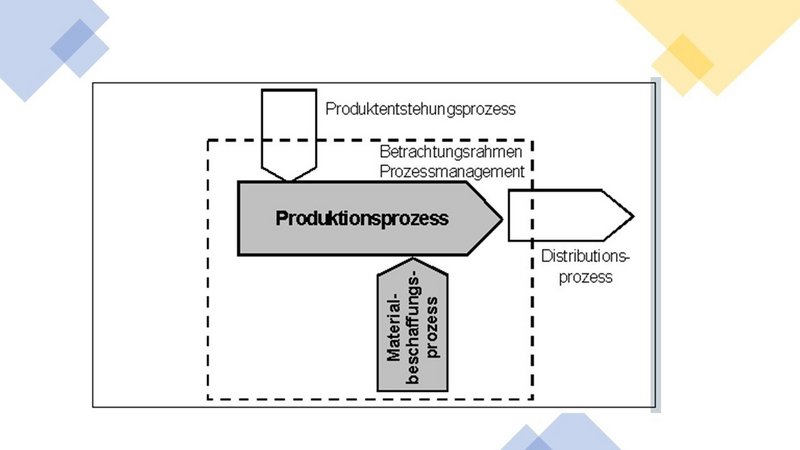
Process management covers the planning, shaping, steering and optimisation of the sub-processes performed as part of the production and material procurement processes. This course also examines the part-processes involved in the upstream product creation process and the downstream distribution process.
Content and methods
Building upon the subject matter covered in the lectures on “Basic principles of process management” (foundation course), this course examines the issues, methods and tools encountered in process, project and quality management – applying the principles of holism, customer focus und flow orientation. This equips students with the skills required to design efficient processes and thus achieve efficient performance in production and procuring materials.
In the belief that “nothing is as practical as a good theory”, the lecture on “Process management” the taught methods will be applied to concrete examples in business practice.
Some of the methods and tools include:
- Supply management as a structured method for shaping the relationships between manufacturer and suppliers
- Value flow analysis as a tool for modelling and analysing value creation processes
- CIP (continuous improvement management) as a means of optimising and redesigning production processes
- Simulation for modelling and investigating dynamic systems, particularly in material flow planning
- Applying statistical methods, e.g. for designing highly variable production or modelling a delivery in sequence
- Using logistic process cost calculations to evaluate entire supply processes involved in production, from supplier to the location of the consumer, to evaluate logically sensible product design
- Using optimisation processes to efficiently allocate material to forms of supply and storage locations
- And a whole lot more.
The more refined and efficiently logistics and production processes are designed, the more significant the reliability, stability – i.e. quality – of these processes will be. As the primary aim of quality management, process reliability is thus an indispensable prerequisite for achieving logistical objectives.