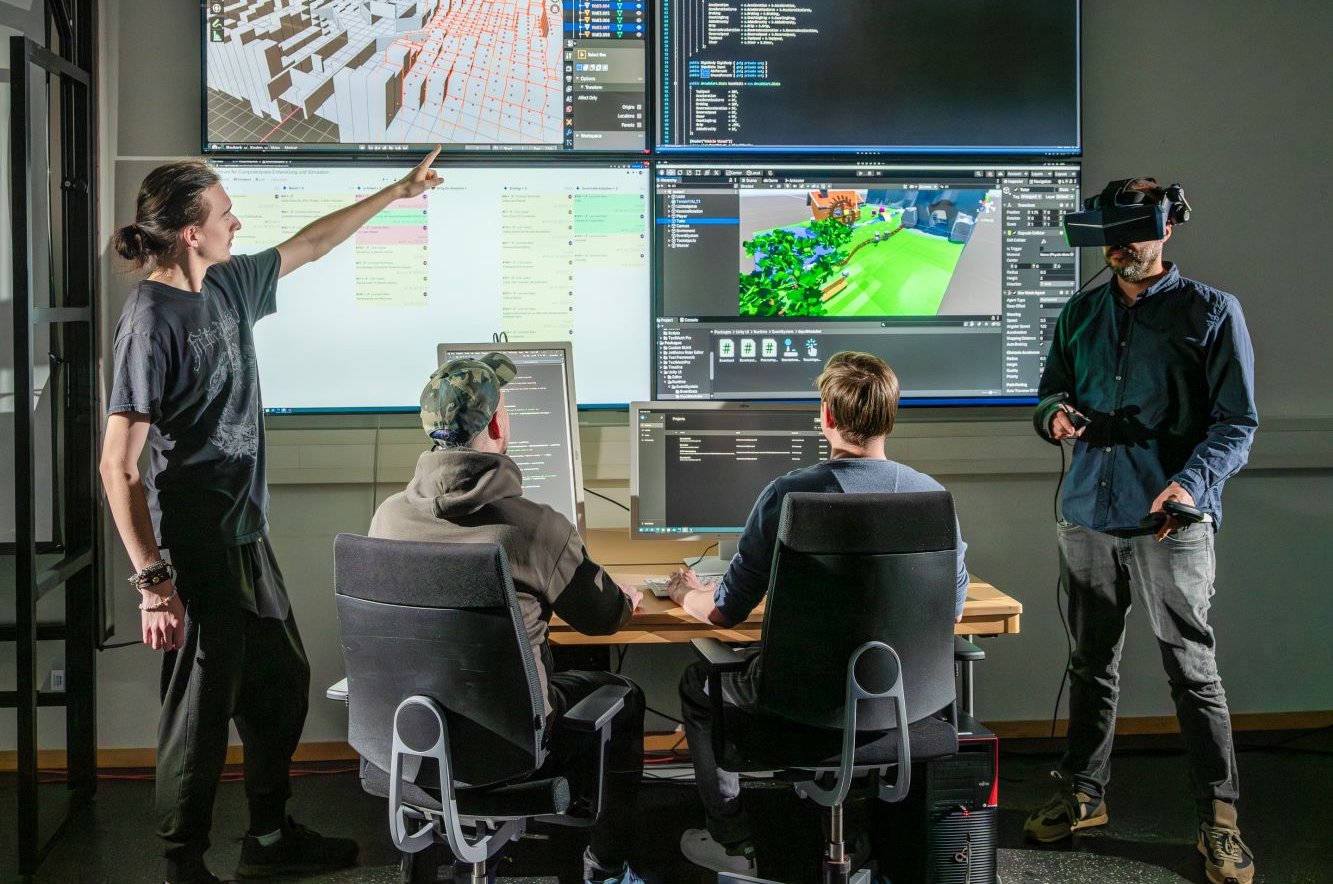
Are you looking for an attractive mix of game engineering, visualization, computer graphics, mixed reality and computer vision, and would you like to develop and help shape digital worlds in computer games and mixed reality applications? Then deepen your knowledge in the visual and creative area of computer science with our master’s degree programme!
The master’s degree programme in Game Engineering and Visual Computing will teach you how the processes involved interact and how they can be applied purposefully in the development of computer games and in a wide range of projects in other industries. This skillset makes you a highly sought-after expert in representing information using digital images.
The computer games industry is developing impressively, with revenue currently estimated to far outstrip that of film, music and print combined. Related but nonetheless separate fields that use hardware, algorithms and methods from computer game development are also rapidly gaining in importance. These include the development of virtual reality and augmented reality applications for simulations and training software, the intuitive visualization of ever larger and more complex data sets, and the art of teaching computers to see with the help of artificial intelligence.
These technologies influence almost all sectors of industry. The master’s degree programme in Game Engineering and Visual Computing equips you with exactly the expertise and skills required to develop brilliant software in this field. You can embark upon this programme directly after gaining your bachelor’s degree in Computer Science – Game Engineering or an equivalent computer science degree programme with a focus on game engineering, computer graphics or similar fields.
At a glance
Qualification
Master of Science (M. Sc.)
Mode of study
full-time, part-time
Standard duration of studies
3
ECTS credits
90
Programme commences
winter semester
summer semesterRestricted admission
no
Taught in
German
Faculty
Computer Science
International studies
optional
Accreditation
German Accreditation Council
Details about this degree programme
This master’s programme is designed to be completed (gaining 90 ECTS Credit Points) in three full-time semesters, but it can also be studied part-time over six semesters.
The first two semesters provide the theoretical basis consisting of compulsory and compulsory elective modules. The compulsory element also includes a project combining practical and scientific, theoretical components, the aim aim being to systematically hone the ability to analyse, adapt and make progress in research-related topics. In each case, the tasks are applied to a specific application scenario, from which you are expected to identify for yourself the topic for the scientific framework.
Semester 3 is devoted to writing your master’s thesis, which is completed either as part of a collaborative project with an industrial partner or in one of the research projects being conducted at the university.
The university awards students who successfully complete the programme the academic title Master of Science (M.Sc.).
The games industry has experienced a remarkable boom in recent years, making computer scientists in the relevant fields extremely sought-after and boosting prospective earnings. The fields of application for virtual and augmented reality go way beyond the entertainment and media industry, as simulations and their visualisation are increasingly turning into success factors in almost all segments. Further examples of applications are to be found in medicine, architecture and building information modelling (BIM).
Application period:
Winter semester: approx. mid-April to 15 July
Summer semester: approx. mid-November to 15 January
Application and admission:
Applications for this master’s degree programme are submitted online via the MeinCampus application portal during the application period.
You can find all important information about your application in the Master application section. There, you will find step-by-step information on how to apply, which documents you need, how admission works and what happens after you have submitted your application.
Admission requirements:
To be eligible for this programme, you must have completed a (bachelor’s) degree in Computer Science – Game Engineering with a grade of at least 2.5, or hold a qualification of equal value. Applicants who gained between 180 and 210 ECTS Credit Points in their bachelor’s degree can make up the difference to attain the skills level of 300 ECTS Credit Points required for the master’s degree from the bachelor’s programmes offered by the university of applied sciences.
Important note: Different or shorter application deadlines may apply for individual degree programmes. Please check the respective degree programme page or the Master application pages for further information.
We ascribe to the values of openness, tolerance and acceptance. Our aim is to teach everyone involved at Kempten University of Applied Sciences about education in an international context. As part of this, we support university-wide, inter-faculty measures to promote international projects and cross-cultural interaction.
Are you interested in learning more about options for you to study abroad? More about opportunities for studying abroad.
We have collated all programme and examination regulations, so you can access all versions and amendments in one place right here.
Programme with extended practice
Study this Master's programme combined with in-depth practical studies! Your regular studies are combined with intensive practical phases, based on the course content. The offer is aimed at both regular, non-dual and dual Bachelor graduates who have completed a combined study programme or study programme with in-depth practice.
Modules at a glance
Compulsory modules
- Advanced game engineering
- Algorithms for real-time rendering
- Augmented reality
- Computer Vision
- Master’s project
- Simulation and data visualisation
- Scientific elaboration of project
Compulsory elective modules
- Algorithms and strategies to support decision-making
- Deep Learning
- Mobile robots
- Parallel programming
- Physically based rendering
- Serious games
- Software architecture