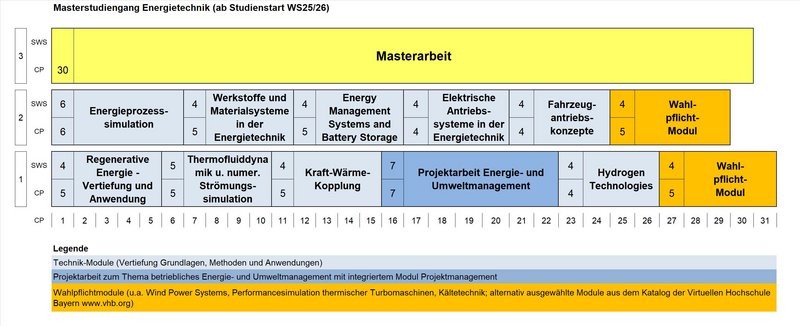
The master’s degree programme in Energy Technology builds upon your undergraduate studies and is designed to take three semesters to complete. However, you can also study for this degree part-time, spread over six semesters in tandem with professional employment in an industrial company or working on a research project.
Tackling demanding challenges in energy technology and related fields calls for advanced knowledge of the energy technology principles, methods and the technologies themselves. In addition, you will be taught the generic core skills for independently directing projects while carefully considering a wide range of business aspects.
The university awards students who successfully complete the programme the academic title Master of Engineering (M.Eng.).
Advanced core principles:
Teaching in additional fields such as thermofluid dynamics, electrochemical energy storage systems
Advanced methods:
Teaching sophisticated methods, particularly software applications such as computational fluid dynamics (CFD) simulations, analysing and simulating complex systems (e.g. power plants or efficient vehicle drives), software for capturing and processing measurement data
Advanced technologies:
Analysis and detailed understanding of the components and systems used in energy technology, building upon the core technical subjects covered in undergraduate degrees, e.g. renewable energies, cogeneration (CHP), energy storage systems, refrigeration technology, vehicle drives, power plant engineering
Generic core principles:
Teaching auxiliary skills, e.g. project management and methods for calculating economic efficiency