Are you interested in cutting-edge developments in the field of production technology and materials? Would you like to grapple with exciting engineering and scientific issues? If so, the degree programme in Production Engineering and Materials Science will prepare you for a versatile career in industry and research and development.
The wide range of manufacturing tasks and specific material requirements in almost all sectors calls for extensive knowledge of state-of-the-art technologies, production methods and processes, materials’ properties and their special characteristics.
This generates tasks relating to scientifically focused applications, manufacturing and production systems, assembly, automation engineering and materials science. Our master’s programme in Production Engineering and Materials Science qualifies you for a leadership role in the production process for technical products, or in developing, designing and applying innovative manufacturing processes and materials. The curriculum has been carefully designed to robustly enhance your skills and equip you with crucial scientific and practically focused specialist knowledge.
Unless otherwise stated, all content on this web page refers to the revised master’s degree programme in Production Engineering and Materials Science starting in Winter Semester 2026/27.
At a glance
Qualification
Master of Science (M. Sc.)
Mode of study
full-time, part-time
Standard duration of studies
3
ECTS credits
90
Programme commences
winter semester
summer semesterRestricted admission
yes
Taught in
German
Faculty
Mechanical Engineering
International studies
optional
Accreditation
ASIIN
Details about this degree programme
The standard duration of study for this master’s degree programme in Production Engineering and Materials Science is three semesters. The first two consist of lectures, practical sessions and project work. In the third semester, the emphasis switches to completing your master’s thesis.
The programme is application-oriented and therefore focuses strongly on practice, but also places a clear emphasis on teaching knowledge-based scientific methodologies, thus making it the only postgraduate programme in the Faculty of Mechanical Engineering that leads to the academic degree of Master of Science (M.Sc.). Its modules in “Special Aspects of Production Engineering and Materials Science” give you access to a range of subjects tailored to cutting-edge developments and current trends in industry. You will usually complete your master’s thesis based in a company or a research-oriented setting, e.g. at one of the university’s institutes.
The university awards students who successfully complete this degree programme the academic title Master of Science (M.Sc.).
Efficient production engineering involves applying specific manufacturing processes to materials with defined functionalities. This is the only way to produce future-focused products with special application-oriented properties. On the other hand, increasingly important questions are being raised about production and materials engineering, as demands grow for careful use of our natural resources, recycling loops and energy efficiency.
Against this backdrop, industry is calling out for scientifically trained engineers with a sound knowledge base in materials science and broad awareness of potential manufacturing techniques and processes. As a result, this master’s degree is not only highly sought after in many sectors, but doors are opened to our graduates in many areas within companies – for roles in project management, specialist consultancy or human resources.
Fields of activity:
- Mechanical and plant engineering
- Automotive industry
- Aerospace
- Medical technology
- Quality and sustainability management
- Academic and industrial research
- Doctoral studies
Kempten University of Applied Sciences has been granted limited rights to award doctorates under the Bavarian Innovation Act. The university’s Centre for Doctoral Studies in Transformation and Sustainable Development offers highly qualified doctoral candidates the opportunity to conduct research and work towards a PhD in relation to the centre’s key areas of research.
Applications period:
Winter semester – approx. mid-April to 15 July
Summer semester – approx. mid-November to 15 January
Application and admission:
Applications for this master’s degree programme are submitted online via the MeinCampus application portal during the application period.
You can find all important information about your application in the Master application section. There, you will find step-by-step information on how to apply, which documents you need, how admission works and what happens after you have submitted your application.
Admission requirements:
Applicants to the master’s degree programme in Production Engineering and Materials Science must have completed a first degree in mechanical engineering, industrial engineering (for mechanical engineering), manufacturing engineering, production engineering, mechatronics, robotics, materials science, mineralogy or a comparable subject area worth at least 210 Credit Points at a German or foreign university.
The final degree average must be at least 2.5 (“good”). Candidates with a grade point average of between 2.5 and 2.8 may also be admitted to the master’s programme in Production Engineering and Materials Science at the discretion of the degree programme’s Examination Board, providing that particular achievements can be demonstrated from before, during or after studying for a relevant bachelor’s or German “Diplom” degree that are pertinent to this specific programme – especially in the fields of production, manufacturing or materials engineering – with evidence of such to be submitted within one year of commencing the programme, at the latest.
If you have not yet received your degree certificate, you can be admitted provisionally. In this case, you will need to append a current transcript of records to your application, showing that no more than 40 Credit Points remain to be completed, with a grade point average of at least 2.5. If the current grade point average lies between 2.5 and 2.8, evidence must be provided of an additional achievement relevant to this master’s programme, as described in the preceding paragraph.
Applicants who have completed a degree without a practical semester, comprising at least 180 Credit Points from theoretical study, will be admitted providing that additional proof of at least 20 weeks’ practical engineering work in a field closely related to mechanical engineering is provided, within one year of commencing the programme, at the latest.
Graduates from a six-semester bachelor’s degree programme with a significant practical component, worth fewer than 210 Credit Points but at least 180 Credit Points, must submit proof of academic and examination achievements totalling a maximum of 30 Credit Points from undergraduate programmes at Kempten University of Applied Sciences or another higher education institution within one year of commencing their studies, at the latest; the Examination Board determines which modules are to be completed or recognised.
Important note: Different or shorter application deadlines may apply for individual degree programmes. Please check the respective degree programme page or the Master application pages for further information.
A Master of Science (M.Sc.) qualifies you to commence doctoral studies either in Germany or abroad.
Would you like to find out more about study opportunities abroad? Click here to learn more about the opportunities for international studies.
We have collated all programme and examination regulations, so you can access all versions and amendments in one place right here.
Programme with extended practice
Study this Master's programme combined with in-depth practical studies! Your regular studies are combined with intensive practical phases, based on the course content. The offer is aimed at both regular, non-dual and dual Bachelor graduates who have completed a combined study programme or study programme with in-depth practice.
You can find more information about the offers here.
Research
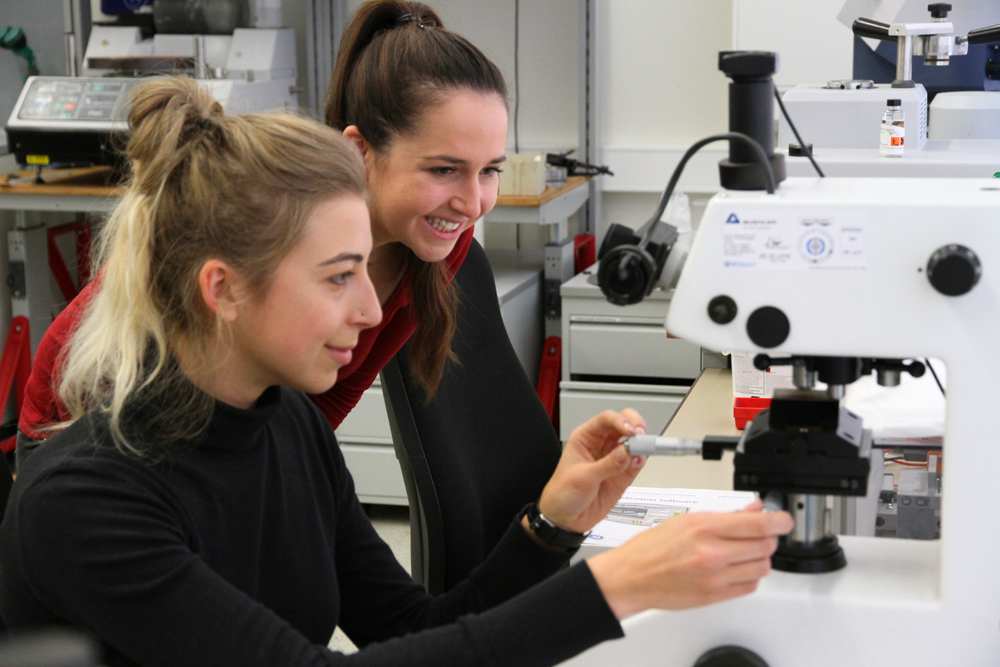
The Institute for Efficient Production Technology (EPT) , with its very well-equipped laboratories, combines scientific research with addressing real issues in practice. Thus not only are the latest findings in production engineering and materials science incorporated into teaching, but students themselves also undertake laboratory placements and project work at the research institutions in question.
Your study place for the Winter Semester 2026/2027
Step 1: Register in the online portal 'MeinCampus' + receive applicant ID (from 27. April 2026).
- Please create your user profile and assign a password
- You will receive an email confirmation with your applicant ID and further instructions to activate your access
- Make notes of your user ID and password in a safe place
Step 2: Assemble documents for digital upload in 'MyCampus':
- university entrance qualification
- official identification document (e.g. identity card)
- For e.g. minors, vocationally qualified persons, dual studies, top athletes and international applicants, further documentation is required (see Overview of required documents).
Step 3: Apply online (from 27. April 2026)
Step 4: Wait for notification of admission
Step 5: Carry out online enrollment
Applications for Winter Semester 2026/27 are scheduled to run from 27. April 2026 to 15. July 2026.
Classes for this semester are due to commence on: 1. October 2025.
For general information on the application process, see::
https://www.hs-kempten.de/en/studies/applications-enrolments/applying-for-a-masters-degree-programme
Programme structure
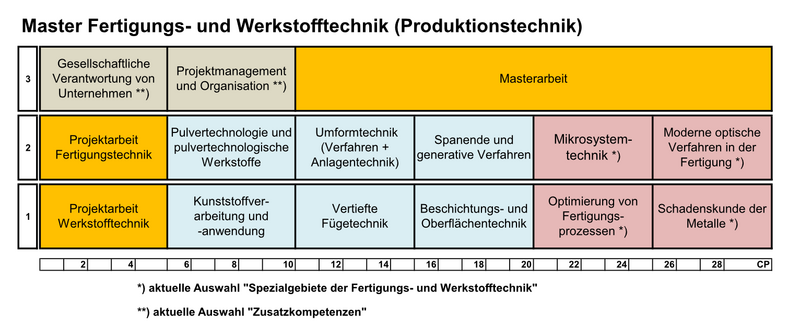
For details of the modules, please consult the relevant Module Handbook.
The standard duration of this master’s degree programme in Production Engineering and Materials Science (Production Engineering) is three semesters. The first two consist of lectures, practical sessions and project work. In the third semester, the emphasis switches to completing your master’s thesis.
The new flyer for this degree programme (for Winter Semester 2026/27) will follow shortly.
Student advisory service
We know how exciting it can be to embark upon a degree programme, so we want you to have someone to contact if you have any questions about studying with us.
Do you have any questions about your degree programme, application, or anything else along these lines?
If so, please don’t hesitate to contact the university’s central Student Advisory Service or an academic advisor.
Donhauser, Christian, Prof. Dr.
Leonhardt, Matthias, Prof. Dr.