Do you want to deepen your knowledge of industrial engineering and acquire useful additional skills? The technical, business and social components of this master’s programme equip you with the optimum skillset to perform a wide range of roles in a company.
The mixture of modules turns graduates into valued managers in various technical sectors, such as automotive construction or mechanical and plant engineering.
Completing this master’s in Industrial Engineering – Mechanical Engineering prepares you for the kind of demanding and interdisciplinary tasks you will encounter later on as a manager. Be that in planning, project management, organising production or business planning – teaching you methods for accomplishing internal and external tasks in mechanical and plant engineering, including its supply industry. Acquiring this useful additional training and core soft skills helps you purposefully develop your technical prowess and personality. Field trips, technical presentations and the application-focused design of modules ensure a high level of practical relevance. Furthermore, students can also work on their master’s theses and projects in close collaboration with an industrial company.
This master’s degree formally qualifies you for senior civil service and paves the way for you to embark upon doctoral studies. Besides boosting professionals career in industry or administration, it offers a gateway to science and research.
Unless otherwise stated, all information in this programme description refers to the current version of the study and examination regulations. If you require information about the previous version, please contact the academic advisory service.
At a glance
Qualification
Master of Engineering (M. Eng.)
Mode of study
full-time, part-time
Standard duration of studies
3
ECTS credits
90
Programme commences
winter semester
summer semesterRestricted admission
yes
Taught in
German
Faculty
Mechanical Engineering
International studies
optional
Accreditation
ASIIN
Details about this degree programme
This master’s degree programme is designed to be completed in three semesters of full-time study, gaining 90 ECTS Credit Points, but it can also be studied part-time over six semesters (approximately halving the weekly workload). Students can switch in either direction between full-time and part-time study. The same admission criteria apply to both options.
The first two semesters each contain two modules on “special aspects of mechanical engineering” and three “interface subjects” examining technological and business-related tasks. Inter-cultural management is also taught during the first semester, before focusing on practical issues and the appropriate approaches to solutions in project work during the second. Expert talks and field trips provide insights into various aspects and suggest different approaches to solutions in industry.
During the third semester, two blocks are offered on communicative and interpersonal skills, while you work on completing your master’s thesis. The final thesis gives you an excellent opportunity to demonstrate your ability to tackle and solve a practically related task using scientific (systematic) methods.
The university awards students who successfully complete the programme the academic title Master of Engineering (M.Eng.).
Study objectives
This master’s programme has been designed to address vocationally relevant subjects, focusing on a number of specific demands for advanced training – particularly project management activities in the following areas:
- Customers’ projects as a sphere of activities that require extensive coordination in order to fulfil individual needs, which are extremely important to many companies in the fields of plant engineering, the manufacture of investment goods, and supply of large-scale series.
- Factory planning as a complex, multi-stage task based on knowledge of a desired output under specific framework conditions through to identifying the required facilities and services.
- Organising production as a perennial daily challenge to deliver the agreed supplies on time, with high productivity and clearly justified stock.
- Business planning as a process that drives innovation, from developing business ideas through to creating the basis for making decisions.
The aim of this degree programme is to teach practically focused advanced findings and industrial engineering methods for mechanical engineering and to train graduates to assume prominent positions in this profession.
Besides subjects that teach the knowledge required to accomplish the above primary activities, lectures are also presented on special aspects of mechanical engineering, e.g. Mechanical Engineering in Practice, Product-Specific Material Selection, Future Technologies.
Masters of Industrial Engineering – Mechanical Engineering are sought after in almost all technical sectors, and at regional, national and international level. You command a broad spectrum of technical know-how – and profound expertise in your area of specialisation – and link this with business acumen and the ability to get things done. These form the ideal basis for performing executive tasks in project development and global project management, right up to senior management in innovative technology companies.
Career prospects und fields of activity
Our master’s degree programme is designed to elaborate sophisticated tasks in the following primary key areas:
- Customer projects (the primary key to success for many companies)
- Factory planning (to meet the challenge of working with complex correlations)
- Organising production (including methods to deliver on time and efficiently)
- Business planning (process to drive innovation, from ideas through to business plans)
This master’s degree qualifies you to lead market-focused or business projects as the gateway to your professional pathway. Your master’s degree will form your gateway to senior positions in public service and leverage promotion.
On the basis of the Bavarian Innovation Act, Kempten University of Applied Sciences has been granted the right to award doctorates in a limited field. The “Transformation and Sustainable Development” doctoral center located at the university offers highly qualified doctoral candidates the opportunity to conduct research and obtain a doctorate in relation to the main research areas.
Application period:
Winter semester: approx. mid-April to 15 July
Summer semester: approx. mid-November to 15 January
Application and admission:
Applications for this master’s degree programme are submitted online via the MeinCampus application portal during the application period.
You can find all important information about your application in the Master application section. There, you will find step-by-step information on how to apply, which documents you need, how admission works and what happens after you have submitted your application.
Admission requirements:
(1) The entry requirement is the successful completion of a Bachelor’s or Diplom degree in Industrial Engineering with a specialisation in Mechanical Engineering at a German or foreign university, comprising at least 210 ECTS credits, or an equivalent qualification. Applications must be submitted with the degree certificate. The final grade point average must be at least 2.5. 4In the case of a grade point average between 2.5 and 2.8, admission to the Master’s programme in Industrial Engineering (Mechanical Engineering) may also be granted at the discretion of the Examination Board, provided that, prior to, during or after a relevant Bachelor’s or Diplom degree programme, particular achievements relevant to the Master’s programme in Industrial Engineering (Mechanical Engineering) – especially in an industrial context relating to technology and economics – can be demonstrated.
(2) The MW Examination Board shall decide on the equivalence of qualifications on a case-by-case basis. The equivalence of qualifications from domestic and foreign higher education institutions shall be determined in accordance with Article 17(1) of the APO. Foreign grade points are converted using the so-called modified Bavarian formula in accordance with Section 3 of the Agreement between the Länder of the Federal Republic of Germany on the Determination of the Overall Grade for Foreign University Entrance Qualifications (Resolution of the Standing Conference of the Ministers of Education and Cultural Affairs of 15 March 1991, as amended on 12 September 2013). If a qualification is not equivalent, equivalence may also be achieved by decision of the Examination Board if missing competences amounting to a maximum of 30 ECTS credits are acquired from the undergraduate programmes at Kempten University of Applied Sciences within one year of commencing studies at the latest.
(3) Applicants from the degree programmes specified in Section 5(1) who have completed at least 180 ECTS credits or at least 140 contact hours from theoretical semesters shall be admitted provided that they can provide evidence of at least 20 weeks’ practical engineering experience in a field closely related to mechanical engineering, to be completed additionally and no later than one year after commencing their studies.
(4) Graduates holding a six-semester Bachelor’s degree with a placement semester comprising fewer than 210 credit points (CP) but at least 180 CP must, no later than one year after commencing their studies, provide evidence of academic and examination achievements totalling a maximum of 30 CP from undergraduate programmes at Kempten University of Applied Sciences or another higher education institution; The Examination Board shall determine which modules are to be completed or recognised.
(5) If the final degree certificate is not yet available, a current transcript of records showing a grade point average of at least 2.5 must be submitted. At the time of graduation, the transcript may show a maximum of 40 CP missing, or, if credit points are not shown, a maximum of 25 SWS. Individual grades shall be weighted in accordance with the relevant study regulations for the first degree. The degree certificate must be submitted to the Registrar’s Office no later than one year after commencing the programme. Paragraph 1, sentence 4 applies mutatis mutandis.
[Source: Excerpt from the SPO, effective as of October 1, 2026; the SPO has not yet been updated, as the University Council’s approval will not be granted until April]
In other words: If you haven’t studied industrial engineering to German “Diplom” or bachelor’s degree level, your application will need to be scrutinised by the Examinations Board for this programme. This is generally a very time-consuming process, hence it will only be commenced once the application has been submitted, as evidence of serious intent.
However, if you have a degree that covers both technical and business content, you stand a good chance of being admitted to the programme. Please don’t send any transcripts of records or curricula vitae to our academic advisors, as they are unable to predict admissions on this basis. If you’re in any doubt, go ahead any apply!
If your grade point average is below 2.5, evidence of work experience in the field of industrial engineering may still enable you to gain admission. Please submit this along with your application.
There are no aptitude tests or recognition procedures for gaining admission to this degree programme if the threshold for the first degree grade is not met.
Important note: Different or shorter application deadlines may apply for individual degree programmes. Please check the respective degree programme page or the Master application pages for further information.
We ascribe to the values of openness, tolerance and acceptance. Our aim is to teach everyone involved at Kempten University of Applied Sciences about education in an international context. As part of this, we support university-wide, inter-faculty measures to promote international projects and cross-cultural interaction.
Would you like to gain experience abroad during your master’s programme? Then add an international twist:
- You can write your master’s thesis at a company abroad and submit it in English.
- A semester abroad can be inserted between the 2nd and 3rd semester (usually extending the duration of your studies). Depending on your host university, content from semester 2 can possibly be studied abroad and counted towards your degree. The International Office can advise you on this, and the Mechanical Engineering examinations board (LINK) will assist with the final adjustments.
- You can arrange alternative options for spending time abroad individually with the Student Advisory Service.
Are you interested in learning more about options for you to study abroad? More about opportunities for studying abroad.
We have collated all programme and examination regulations, so you can access all versions and amendments in one place right here.
Programme with extended practice
Study this Master's programme combined with in-depth practical studies! Your regular studies are combined with intensive practical phases, based on the course content. The offer is aimed at both regular, non-dual and dual Bachelor graduates who have completed a combined study programme or study programme with in-depth practice.
You can find more information about the offers here.
Your study place for the Winter Semester 2026/2027
Step 1: Register in the online portal 'MeinCampus' + receive applicant ID (from 27. April 2026).
- Please create your user profile and assign a password
- You will receive an email confirmation with your applicant ID and further instructions to activate your access
- Make notes of your user ID and password in a safe place
Step 2: Assemble documents for digital upload in 'MyCampus':
- university entrance qualification
- official identification document (e.g. identity card)
- For e.g. minors, vocationally qualified persons, dual studies, top athletes and international applicants, further documentation is required (see Overview of required documents).
Step 3: Apply online (from 27. April 2026)
Step 4: Wait for notification of admission
Step 5: Carry out online enrollment
Applications for Winter Semester 2026/27 are scheduled to run from 27. April 2026 to 15. July 2026.
Classes for this semester are due to commence on: 1. October 2025.
For general information on the application process, see::
https://www.hs-kempten.de/en/studies/applications-enrolments/applying-for-a-masters-degree-programme
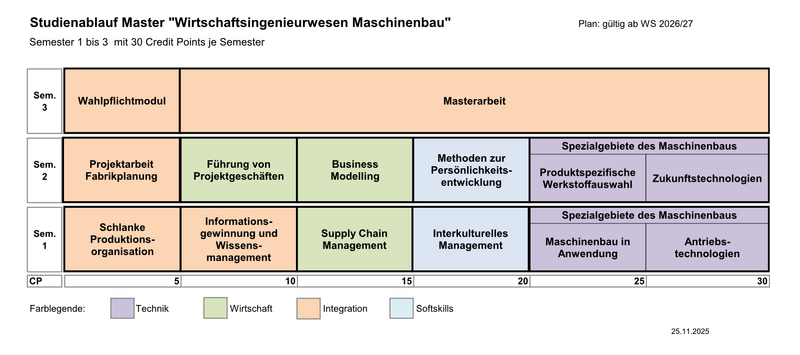
For details on the modules, please refer to the current module handbook.
This master’s degree programme is designed to be completed in three semesters of full-time study, gaining 90 ECTS Credit Points, but it can also be studied part-time over six semesters (approximately halving the weekly workload). Students can switch in either direction between full-time and part-time study. The same admission criteria apply to both options.
Student advisory service
We know how exciting it can be to embark upon a degree programme, so we want you to have someone to contact if you have any questions about studying with us.
Do you have any questions about your degree programme, application, or anything else along these lines?
If so, please don’t hesitate to contact the university’s central Student Advisory Service or an academic advisor.
Seeberg, Barbara, Prof. Dr.