A new open-access paper by Sheng Yin and co-authors has been published in Applied Energy. It shows how a battery controller learns directly from raw time series, without any forecast.
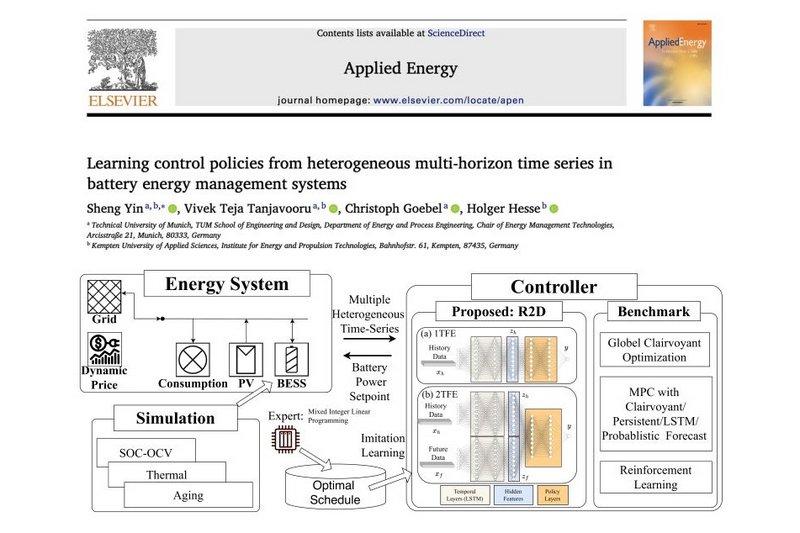
Most battery energy management systems work in two steps: first, load, PV generation and prices are forecast, and then the system is optimized. The catch is that a better forecast doesn’t always lead to a better decision.
Our new open-access paper in Applied Energy introduces R2D (Representation-to-Decision). R2D learns battery control policies directly from historical and future time series by imitating an aging-aware MILP expert.
Results:
- 62–77 % of the global clairvoyant optimum across 5 industrial sites
- outperforms the MPC and RL baselines we tested
- battery degradation nearly identical to the MILP expert (teacher)
Authors: Sheng Yin, Vivek Teja Tanjavooru, Prof. Dr. Christoph Goebel, Prof. Dr. Holger Hesse
Links:
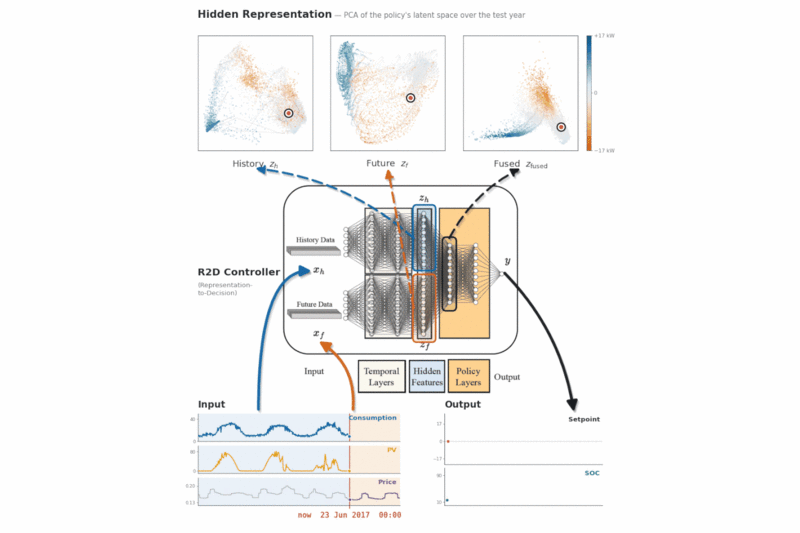
The GIF runs one test day, one frame every 15 minutes. 72 h of history and 24 h of future go in, and a battery setpoint comes out. The three maps show how the network understands the history, the future and the two combined, each reduced to 2D with PCA. Charging (blue) and discharging (orange) occur separately, with no forecast in between.